 University of North Texas

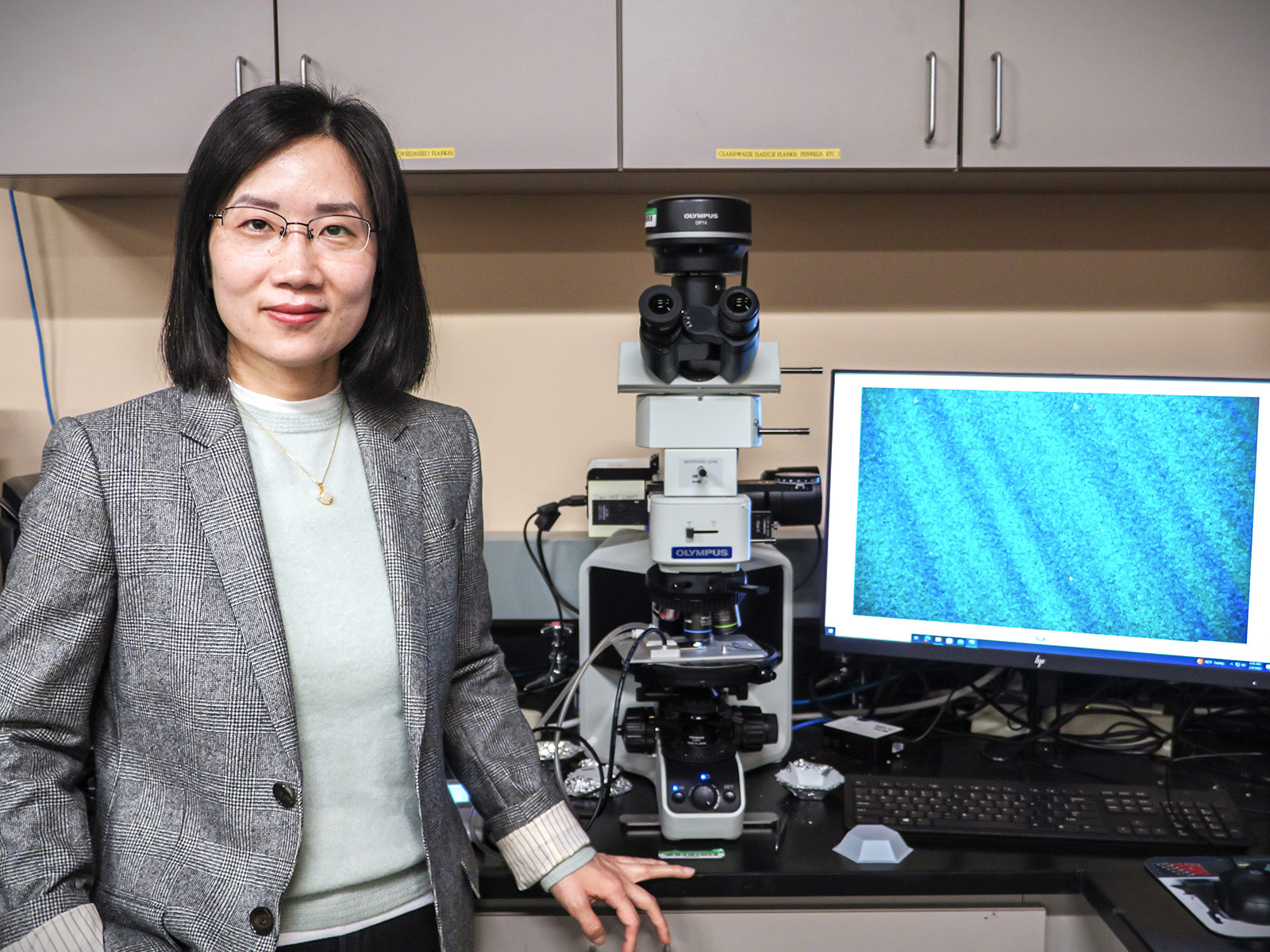
DENTON (UNT), Texas — As wearable technology becomes more popular in healthcare, fitness
and defense applications, researchers are looking for materials that can bend, stretch
and adapt to the human body’s movements while still transmitting information efficiently.
At the University of North Texas, researchers are developing a new kind of flexible material that could lead to the
next generation of wearable devices.
“We’re focusing on the signal communications for those devices,” said Xiao Li, an
assistant professor in materials science and engineering. “We want to deliver a message — the data — without interruption or physical contact.”
Many wearable devices, such as smartwatches, use rigid electronic components that
can limit their ability to conform to a curved surface. Researchers have begun looking
into a material called photonic crystals. These crystals control how light moves through
them which leads to fast and efficient data transmission.
“However, traditional photonic crystals are very rigid,” Li said. “That’s why we’re
going one step beyond this and studying a type of photonic crystal called blue phase
liquid crystals, which is a recent idea in the field.”
Liquid crystals are a state of matter between liquid and solid. Blue phase liquid
crystals have a highly organized, microscopic 3D structure. Because of their soft
nature, they can easily self-assemble into curved shapes and can instantly change
how they interact with light when given just a small nudge.
“Normally, people study the behaviors of this material on a flattened surface. Only
in the past five years or so have researchers looked at it on that curved surface.”
Li is working alongside Associate Professor Giordano Tierra in the mathematics department on the project. While Li and her team design and test the material, Tierra will create
simulations based on the data they provide. The simulations will give insight into
how the structure evolves under different conditions.
“We’ve designed these circular patterns with curved surfaces that we’ll fill with
the liquid crystal,” Li said. “Then we’ll see how the sample responds to external
stimuli to know if the structure formed properly or if it evolves or devolves with
the stimuli.”
Because the structures exist on the molecular level, researchers cannot directly observe
every stage of their formation. That’s where Tierra’s simulations will fill the gap.
“Once we figure out those two parts, we’ll move to 3D printing and create a printable
substrate version of the material. By the end of this project, we hope to have a demo
piece of this printed flexible material with 4D capabilities.”
A 4D material is one that responds to external stimuli. For example, if the skin temperature
changes, the material will change colors. It could also expand or shrink when exposed
to UV light.
The project is being supported by a $360,000, three-year grant from the Army Research
Office. Li acknowledges it will be a challenging project as blue phase liquid crystals
are notoriously difficult to manipulate. Their watery nature makes it difficult to
form them into a stable structure, and they only exist within a narrow temperature
range. Both characteristics make them hard to use in 3D printing.
Despite the challenges, Li believes the potential benefits are worth pursuing.
“We’re focused on inventing this 3D printing technology for processing our material,
this new material. This will help create new sensors that can immediately adapt to
bending, stretching, even wrinkles. There are endless possibilities.”