 University of North Texas


FRISCO (UNT), Texas — The Texas Talent Accelerator brought together North Texas business, education and workforce leaders Oct. 26 for an inaugural Workforce Leadership Summit examining how artificial intelligence, evolving skill demands, and regional collaborations are shaping the future of work.
Founded by the University of North Texas in September 2025, the Texas Talent Accelerator is designed to strengthen the North Texas talent pipeline by bringing together the region’s stakeholders to drive continued growth and keep the region — and the state of Texas — competitive.
“As I travel across Texas and across the country, so many people have told me they wish they had what we have here in North Texas,” said UNT President Harrison Keller, Ph.D., pointing to the North Texas region’s growing population, economy and network of colleges, universities and workforce partners. “We have a thriving, diversified economy and a strong network of community and technical colleges, universities, and workforce partners. But we also know that too many people across our region still lack clear paths to the good jobs we're attracting and creating here in North Texas.”

The Texas Talent Accelerator is helping change that, Keller said. He emphasized the importance of preparing students with durable skills, including communication, critical thinking and the ability to evaluate information. As technology and the economy change, meaningful work experiences before graduation help students learn to apply those skills in different settings, he said.
The summit brought together employers including American Airlines, Bank of America, DATCU, Deloitte, TIP Strategies, and USAA, as well as the Dallas Regional Chamber, leaders from economic development corporations, and nonprofits such as Braven, Strada Education Foundation, the Tarrant To and Through Partnership, and Trellis Strategies. Higher education institutions included Collin College, Dallas College, Texas A&M University System, Texas State Technical College, Texas Wesleyan University, Texas Woman’s University, the University of Texas at Arlington, the University of North Texas and others.
AI’s Impact on Talent
The summit’s morning keynote panel, “AI’s Next Move: What It Means for the Talent Pipeline and Regional Growth,” explored how artificial intelligence is changing job responsibilities, entry-level opportunities and skills employers need.
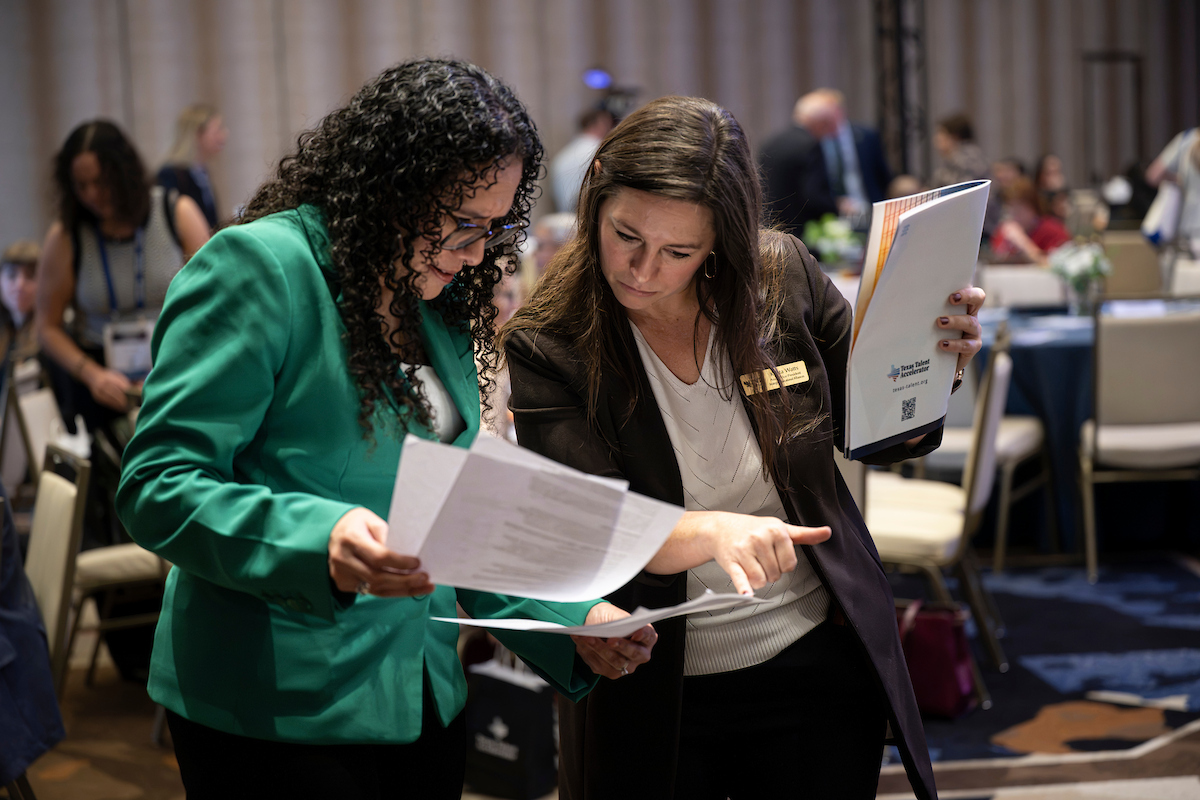
Discussions throughout the day addressed how employers can develop talent internally as AI reshapes roles, what labor market data can reveal about job risk in North Texas, and how education and workforce partners can respond to emerging skills needs.
Jarrad Toussant, senior vice president of education, talent and workforce at the Dallas Regional Chamber, led a session on internal mobility and reskilling as employers adapt to AI. While technology is changing how work gets done, human judgement and decision-making remain important, he said.
Elizabeth Nieto, senior vice president and global head of talent and culture at American Airlines, highlighted the need for employers and education providers to work together to prepare workers with relevant skills. She noted opportunities for institutions to respond to employer needs through curriculum, credentials and upskilling.
Simona Spelman, U.S. human capital leader at Deloitte, discussed the pace of AI-driven change and the need to help students develop good judgment and apply their knowledge in real-world settings. Internships and other practical experiences can help students understand how professionals approach complex decisions, she said.
Experiences to Build Talent

Work-integrated learning was another focus of the summit. David Saenz, Ed.D., president and CEO of the Tarrant To and Through (T3) Partnership, discussed how structured, career-aligned experiences give students practical skills, coaching and feedback while helping employers introduce future workers to their industries and workplace cultures.
“As AI reshapes entry-level work, what students do before graduation matters more than ever,” Saenz said.
Additional sessions addressed credentials and graduate outcomes, skills-first hiring,
emerging career pathways and regional economic competitiveness. Participants also
explored ways to expand economic opportunities for adults who have some college credit
but no credential and make education and training more accessible to working adults.
North Texas’ Next Chapter
The summit concluded with “From Ideas to Action: Shaping North Texas’ Next Chapter Together,” a collaborative session focused on the region’s future workforce needs and opportunities for continued partnership.
Michelle Singh, UNT vice president for strategic educational alliances and executive lead for the Texas Talent Accelerator, spoke of the value of coordinating efforts across employers, educators and economic development organizations.
“When a region coordinates talent development as a system, employers and people connect to opportunity faster than they do in regions with scattered programs,” Singh said.
For more information about the Texas Talent Accelerator, visit texas-talent.org.